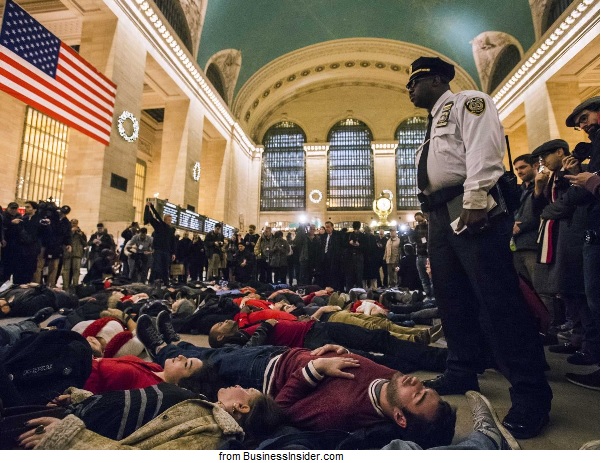
By now, most of the civilized world is aware of the two separate cases here in the USA of a white policeman killing a black male suspect during an altercation. They come on the heels of so many other similar incidents that have resulted in the death of a Black suspect or even a completely innocent Black man. While the dialogues have been endless and heartbreaking, none have addressed four aspects of American society that crucially influence how these events are perceived. Until we are willing to admit to and examine these factors, these tragedies will continue to divide our nation, eventually destroying us all:
1. We have been trained to have an “Us versus Them” mentality.
Bill O’Reilly versus Jon Stewart. Christian versus Muslim versus Atheist. Liberal versus Conservative. Male versus Female. White versus Black. The listings are endless. Belonging to a group makes us feel comfortable and welcomed, makes us feel that we “fit.” But the moment we affiliate ourselves with any one group, we limit our world view. When we’re herded into group think by our religion, our ethnicity, our favorite news channel or political party, we begin to lose our ability to feel compassion for anyone outside our group. Those who dare to think differently from what their group deems to be true know they’ll be criticized and possibly ostracized from the one place they feel they belong. It’s frightening to be excluded, to stand alone. But unless we can teach ourselves to be open-hearted and open-minded enough to see human beings as one giant group, unless we can be brave enough to stand up for what we know in our hearts is right, whether our group agrees or not, human suffering will not end. Whether we accept this or not, we’re trained from the time we’re very young to think “Us versus Them.” It keeps us aligned to that which others ̶ our parents, our political and religious leaders ̶ wish us to be aligned. An allegiance to one specific group can make us fearful, ready to perceive “outside” threats to ourselves and to what and whom we love. All of this in turn keeps us willing to participate in war, whether actual or metaphoric. Group think breeds fear and fear breeds violence. And only the very few profit from that.
2. We refuse to recognize and examine our own personal, knee-jerk prejudices.
My knee-jerk prejudices are something I’ve acknowledged as an ugly part of me that exists, whether I like it or not. I have a number of preconceived notions that are often subtle and hard for me to pinpoint. But make no mistake: when I come across them, I’m disgusted with myself. For example, I’ve recently noticed a stiffness in my demeanor whenever I talk to white, male lawyers. I realize it’s their profession and their privilege that make me predisposed to distrusting them. But when I meet someone new who fits this description, I now know that I’m actually waiting to discover something about them that will justify my automatic distaste. That’s only one of my personal perceptions that I need to be aware of, but years ago, I discovered one in particular that is at the root of many social evils. I call it “The DeKalb Avenue Subway Stop Syndrome.” In the early 1990s, when I was teaching at an inner city school, a father came to Parent-Teacher Night with his daughter, my pupil. He sat with her at my desk and listened without expression as I told him about her accomplishments in my class. (She was a model student.) After I’d finished, he said, “I just have one question: Does she talk a lot in your class? Because at home, I can’t get this little one to be quiet.” To which my pupil replied, “Oh, Daddy, please. Don’t embarrass me.”
After they left, I wondered why, after witnessing the exchange between father and daughter, I felt an inexplicable relief followed by a wave of shame. Then I realized what it was: He was a muscular man in his mid-thirties, with very dark skin. When I was a little girl, my grandmother lived in Brooklyn, New York. She’d sometimes take me on New York City subway rides when I went to visit her. If the subway car was empty save for us, and a young black male got on at the Dekalb Avenue stop, my grandmother would pinch me and make a motion with her eyes that we needed to get up without attracting his attention and move to the next car. Dekalb Avenue was notorious for being a “dangerous minority area,” and young Black men would sometimes get on at this stop, go up to passengers and pull their gold chains off right from around their necks. “Chain snatchers” as they were called, could then be seen at the Sixth Avenue Diamond Exchange in Manhattan selling those chains. I’d seen this happen even as a young woman working in Manhattan, and unconsciously, this fright had stayed with me throughout my childhood and all throughout my thirties, my anxiety over it not resurfacing until a loving father came into my classroom to see how his daughter was faring at school. He was no threat to me nor to anyone else, but until he spoke, his stoic expression, his skin color, his build, made me wary on some deep level.
It took only that one exchange between him and his daughter for me to uncover this irrational perception I had about him, but how can I know for sure if I’ve caught my subconscious every time it’s set on a similar course of unreasoning fear? Though I try to be a good person, though I wish good for all men, there still was that knee-jerk xenophobia, hidden within me.It’s hard to admit this despicable side of myself, but I hope by being aware of it, I can stop myself from reacting to these gut emotions rather than to the actuality of the situation I’m in. I wonder, if we were all to be this blunt with ourselves if many of the altercations such as the ones we’re hearing about in the news could be prevented?
3. We are naïve in our belief that our personal experience with law enforcement is the collective reality.
As a person who’s worked in a minority community of abject poverty, and then eventually moved to one of the wealthiest neighborhoods in the United States, I can attest from firsthand experience that there are terrifyingly opposed exchanges one can have with law enforcement individuals, exchanges that are too often based on where one stands on the socioeconomic divide. From Queens, New York, to Marin County, California, I can cite personal example after personal example the gulf between my dealings with law enforcement when seen as a rich woman and when seen as a poor one. I believe without one shred of doubt that the more affluent the community in which one lives, the better the exchange with law enforcement individuals one will have.
Do the mindsets of police officers change when they’re exposed to high crime rates, constant danger and the despair of poverty? Probably somewhat. But will these problems turn a good police officer into a bad one? Definitely not. There are bad people who join good organizations with the sole intention of taking advantage of their position in society to wreak havoc and cause harm. That is an undeniable fact of life. And what do we too often do about these corrupt individuals within any organization? Do we expose them, strip them of their jobs, or do we hide them away for fear that outing them would be a threat to the organization as a whole? As a teacher, I witnessed other so-called “teachers” who were a mental and physical danger to our pupils as they were shuffled from school to school in a “lemon dance” effort to lessen their negative impact. But rarely did I see any of them who had tenure be sent home for good.
This “one for all and all for one” mentality holds true (and we know it does) with doctors, politicians and priests. As it does too with bad police officers. Until we call out and expose the unnecessarily violent, the ones who see themselves more as almighty enforcers rather than peacekeepers, until the general mindset of police administration in the ghettos becomes one of compassion rather than suppression, the rotten apples will thrive, eventually instigating an exodus from law enforcement by those who truly wish to serve and protect. It was revolting to us when we heard of the bishop who covered up the sexual abuse of hundreds of Catholic children, and the doctor who fraudulently prescribed cancer treatments to his patients for greed and profit. Why all the justification for every violent police action? Why no deep investigation into these current cases, no task force to get to the root of the problem? Why isn’t every American demanding such? Where is our community spirit? Surely we’ve all learned from Martin Niemöller ‘s famous quotation, “First they came for the Jews,” that saying nothing because it’s nothing to do with “us” personally can only lead to it becoming us, personally.
4. We have taught our sons and daughters a grotesque ideal of “masculinity.”

Despite my belief that the police officers involved in the Brown and Garner cases should have been, at the very least, indicted to stand trial before a jury and defend their actions, I also believe that they too are in another way, victims of a society that teaches all of us that the only true masculinity is a violent masculinity. In fact, we’ve sexualized violence in our society: the man who kills most in a war is a “hero,” and a “catch,” the “hottie” criminal mug shot that goes viral, the police uniform as a turn on. As mothers, there are those among us who’d encourage their sons to join the military but would disown them if they were gay, or who tell their toddler sons that boys don’t cry. Because of our twisted approach to what is male, what emotions a man is permitted and not to exhibit in public, four times more men than women commit suicide. Men who are depressed don’t dare display the “female” emotions of sadness or despair, but instead indulge in “anger, aggression, irritability, substance abuse and risk-taking behaviors.” And too many lower income men between the ages of 17-19 join the military not out of any true sense of patriotism or a desire to protect, but because they can’t think of anything else they can do to prove themselves men.
Our approval of this culture of violence shows itself in how our men behave, not only towards each other, but towards women. Much is said about how modern society makes being a female challenging, but not enough is said about how we begin to warp a boy baby’s mind from the moment he’s off the nipple and begins learning how to walk.
Taking all of this into consideration, the need for men to prove their masculinity through aggression is epidemic and many male military personnel and law enforcement officers are drawn to these occupations simply for the opportunities they afford them to express their aggression. With this as a factor, it’s my bet that Darren Wilson approached or replied to Michael Brown with hostility (although he says not) because that’s the way the “man in charge” has been taught to approach or reply, particularly if he has his own masculinity issues, something that the police department needs to evaluate before putting officers out on the streets to patrol. And I’d also bet that Michael Brown replied in kind or led with aggression, because an 18-year old male could never survive socially (maybe even physically) if it ever got out to his peers that he did not stand up for himself and show himself to “be a man.”
So while we’re all screaming about which “side” is at fault in these altercations, there are those of us who see a societal problem that is wider and deeper than race alone. Who can resolve it? I think women can. At least, we should consider that we be the ones to try.
As mothers and grandmothers, aunts and teachers, as the segment of humanity which has been burdened or blessed with the ability to bring forth and nurture life, we need to take a more active role in promoting compassion. We need to take a wider role in looking out for each other’s children. We need to speak up against violence, not justify it. We need to oppose war rather than glorify it. And most of all, we need to make our male counterparts believe that these “feminine” traits are also masculine traits, traits that we admire and desire to see them display.
Leave a Reply