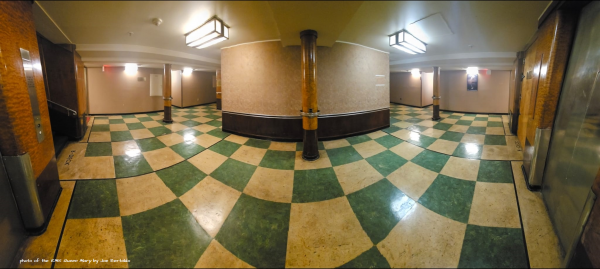
Once upon a time, four very different women got together, and decided to open a restaurant aboard an historic, haunted ocean liner — the real-life, 1930s RMS Queen Mary.
Well, they actually didn’t, but in my first novel, Cooking for Ghosts, they did.
That novel and the two in the trilogy that followed it were well-received, I’m pleased and honored to report. I’ve become confident enough now to credit myself (without prevaricating) for the writing, but even so, I believe these three novels might well have remained forever unwritten were it not for the writer who coached me along the way, Deborah Grabien. If her name is unknown to you, start by reading Plainsong. (Kindle has it for 9.99) Even if you’re not into post-apocalyptic fantasy, the crispness, the poise, the passion, and assurance of the writing is undeniable. Grabien is one of our best living writers today. It doesn’t serve this essay to tell you how we met, just that I asked her if she would be my ‘guide’, so to speak. I did have two non-fiction books under my belt, but it felt like a giant leap to switch from non-fiction to novels. So, I’d send her a chapter or two, and she’d comment on it. Every few days, she got another email with writing attached. Sometimes she’d get two emails, the second stating (anxiously) “Please don’t read what I sent earlier, please read this version instead.”
An unusual arrangement, for sure, but I am so thankful she agreed to it. This association constituted one of the most rewarding experiences of my writing life. Not because she was forever praising me, mind; in fact, sometimes I’d get a note: “Banging head against desk.” Yes, she would, when she felt it necessary. She expected I could do better than the draft I’d sent her. And what I understood in her reproach was that she thought I was worth her time, even her frustration, because she believed, (as she later told me) that I was a “real” writer. A praise I treasured coming from her as the source.
I still have her notes, from that time— her suggestions, her questions, her enthusiasm as she got into the tale that she was helping me weave. And when, every now and again, I would, for no particular reason, doubt myself, she’d say, “Snap out of it.” And when I’d ask her, “Should I write it this way, or…?” She’d answer, “Is that the way you think it should be written? Yes? Then write it that way.”
She was not a paid sycophant, she was a genuine believer in my work, and a mentor. She didn’t write my book for me; she pulled me into the world of my own imagination and kept me there. She helped me hone my skill until I truly felt I was the writer I’d always wanted to be.
Just as rewarding a part of that writing journey was the research I did for that novel and the two that followed. Though fiction, there was much authenticity weaved in. For example, on each stated date in the stories, the weather was the reality for the setting, and even the moon phases were actual. All the historical events were real, anything that was changed in service to the plot was detailed in the author’s note at the end of each book. I spent the most time on descriptions of place, as I wanted every reader to feel as though they were aboard the actual Queen Mary. Or in Glasgow, Scotland, 1934, or New York City, 1956, and so on. I spent weeks reading and exploring each place, each time, each event. Some might imagine this was tedious work, but for me it was exhilarating and educational, to search for precisely what I needed to know, so I could paint the word picture I wanted to paint.
And then there were the interviews, captivating conversations with chefs, food critics, a martial arts expert, a dialect coach, a UK historian, a Latin teacher, a police officer, a Commodore, a war bride, a ship model maker, a paranormal researcher. A friend pulled in a favor with a District Attorney who helped me determine what the maritime law would dictate on a crucial plot point.
But, that’s not all. For the second book in the trilogy, I got to speak with the world’s greatest magician, David Copperfield. Oh, the thrill of it, listening to him talk passionately for an hour on what it takes to put together a grand magic performance. I learned what tremendous effort goes into that, from the very man who vanished the Statue of Liberty. And then to hear him tell me, after he read the work that I’d, “truly gotten it.” I’ve always been a fan of magic, his in particular, so those interactions with him were another highlight of my career. By the time I was writing Book III in the trilogy, my son and I traveled to New Orleans, to interview a “mambo”, an actual vodou priestess, and have dinner with a “houngan”, a vodou priest. Two more mind-opening experience, this time for both my son and me.
And when Cooking for Ghosts was published at last, suddenly I was talking with self-proclaimed “ship geeks”, aficionados of historic ships. Some passed through my life, like, as the saying (appropriately) goes, “ships in the night,” but others? Here’s something wonderful I never dreamed would happen: To this day I remain close friends with several. And as I drafted Book II and Book III in the trilogy, I didn’t have to guess or research on my own where, say, a body could be hidden aboard the actual ship; my lovely ship lover friends knew just how and where I could hide that body for my story. Two friends even sent photos, with diagrams. I was invited on three different private tours of the Queen Mary by those knowledgeable friends who took me through every part of that magnificent vessel. Every detail of each novel is rife with their input, none of it faked, none AI-hallucinated— it was all passed on to me via genuine, enthusiastic human beings, who gifted me with their real expertise.
If you read the acknowledgements in all three books, you will see that the details in the story, which some readers might never even notice, are thanks to all of them, and more. There were so many people to be grateful for, so many fascinating conversations to remember.
And all of it did not cost me even one “token.”
I am in anguish over the fact that writers and other creatives of my son’s generation, and the generations that come after him might never have this kind of an artistic experience. I am in anguish over the shoving down our throats of AI, that “helps” you write a book with none of these life-affirming exchanges and connections. You are talking to a machine. A machine that is sucking up fresh water and energy, that is charging you money for something that should be given to you by other humans who learned what they know organically, and are so very happy to pass their wisdom onto you. Of the two writing experiences, which would you think feeds both writer and reader more, both spiritually and mentally?
Then came Covid, a period of our history which those in power are now trying to rewrite. (Tragically, they will succeed.) A few months before we dealt with virus lockdowns, Book III in this trilogy was released, as were the audiobook versions of the three novels. Their launch into the world was lost to the death of millions of us. But it didn’t just happen to my work. Art and culture came to a standstill. Book launches were cancelled. Music events were cancelled. Films that were in production stopped production. Most everyone in every arts community was out of work, some never able to recuperate from the loss of momentum. And while we waited for this plague to pass, the world of the arts was altered forever. The most dramatic first change being new-release films sent to streaming as well as theaters, the start of the box office fall, of “at home” entertainment, “at home’ socializing, “at home” school and work.
We now live in a simulation of our own making. An existence where the people we “meet”, with whom we interact online, do not look the way they pretend to look, nor lead the lives they pretend to lead. Even worse, many are not people at all, just pixels. Simulated faces, voices, and words. Photos that aren’t real. News that never happened. Information doled out, carefully curated via algorithms to give us only the data they want us to have so that we’ll think only what they want us to think. We’re given different versions of reality based on what they know about each one of us, our likes and dislikes, what makes us comfortable, what scares us, what makes us angry. A “feed” is the right name for it, indeed. It doesn’t enrich and enlighten and educate, but shrouds, beguiles, and hypnotizes. Our leaders lie to make us afraid and thus compliant, and the more we believe them, the bigger they lie. They are stealing our economy, our environment, our water, our freedoms, our peace, and our sanity.
And the one solace we’ve always had, the one thing of beauty created solely by us that allowed us to remember that we are human with psyches and essences and souls, not just slaves to those who hoard the fruits of our labor, was our art. Our stories, our books, our music, our films, our paintings and photographs. Now, it’s all faked, all created with a “prompt”, all easily deleted with the press of a key. Even our money is now to be nothing more than tiny dots that make up the representation of a digital image. One minute you have a movie or book or song in your “digital library”, a library you paid for, that they told you was yours, and the next that library disappears, taken away by the same people who sold it to you. One minute you have your crypto currency… and the next? Who gets to decide when that disappears, and why?
Some of us think the digitalization of our lives is a good thing, a ‘simplified’ thing, an ‘easier’ thing. Some are not even aware of it, fully convinced that what they see online, what they hear from their chosen leaders, is truth. And some, mostly young people, are terrified of it. Because they understand it for what it is: Their life experience twisted and curtailed. Their own intelligence, their own creativity replicated, stolen from them, then altered and sold back to them, if they can afford it, if a livelihood will exist for them so that they can pay for it.
Our young people feel both anxious and hopeless over the embezzlement of their future by tech robber barons, and not many baby boomers in my outer circle of acquaintances— a rather large circle, as well— understand that, or care to know that. And I find myself mostly alone in my age group, shattered by what I’m seeing and hearing, what I am predicting will be begotten upon future generations by the dull-witted and docile, the short-sighted and submissive, the self-centered and greedy among us.
I thought I’d finally gotten to a time in my life when I could write my stories in peace, enjoy my garden, love and relish my family and friends, and live out my years. Instead I feel compelled to do what I can with the remainder of my time on this beautiful planet which is slowly being murdered by the same proponents of AI, to at least help some young people retain moments of spiritual joy, retain their art, the one thing above all else that’s never failed to make me happy that I exist.
So, in place of the life I had planned for my last years, here’s what I’m doing instead:
A collective of us have a plan to help young people make art— films, in particular— without the fear that their images, their work, will be appropriated— one drop of their life blood at a time— to be added to the bottomless coffers of the 0.001 percent who neither know nor care about any of our young people, including their own children.
It’s a grandiose plan, for sure, and one that if it succeeds will not reach its pinnacle until after I’m gone, nonetheless it’s already in the works. There’s always the chance it won’t make much of a dent, of course, but it’s my own form of rebellion against the Empire. Those reading this who believe that the youth of today deserve more than their getting, those who are of a mindset that the pursuit of liberty, wellbeing, and happiness are rights to which we are ALL entitled, I hope you’ll become part of this new journey.
I’ll be writing more about it very soon.
[Photo of the RMS Queen Mary “B Deck” by Joe Bertoldo]
Leave a Reply