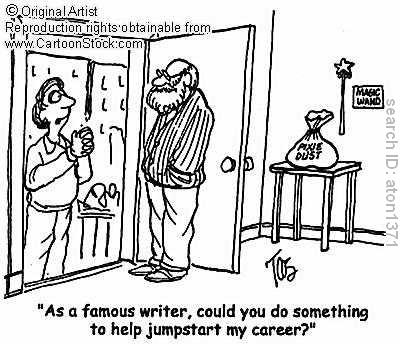
Now that you have your newly-edited manuscript down to 143,122 words, (not including the 36,310 words of the ‘Back Section’ which includes recipes, a guide to additional reading, a history lesson, a wine list, and other information you deemed pertinent to your readers as addendums to your manuscript), you start looking for a book publisher. The only problem there is that you have no idea how to find a book publisher. Someone wiser than you, or maybe someone who just overheard someone else talking to another someone about this, suggests you get a “literary agent”. But you’ve no idea how to find one of those, either. So:
1) You go into your husband’s office and ask him, “Have you any thoughts on how I can get an agent for my women’s empowerment memoir?”
Your husband, a stockbroker who reads the financial pages, baseball biographies, and P.G. Wodehouse, and is at that very moment trying to make an important stock trade, replies (quite flippantly, you think), “None whatsoever.”
2) Unreasonably irritated, you leave his office, go back into your own, and type, “How to Get A Literary Agent” into the search engine on your computer. This is when you discover that Google has approximately 818,000 articles on how to find a literary agent, and amazon.com sells more than 50 books on the subject.
Surely you don’t need to read a whole book and all those articles? After all, how hard can it be to get an agent? Aren’t they like realtors? Don’t they want to sell your work? That’s how they make their money, after all, isn’t it?
Thus, assuming that selling a work of literature is like selling a house, you choose to follow the directives in a concise, one-page article you find on ehow.com.
3) The ehow.com article says that you need to first write a ‘query letter’ to an agent. Again, you are clueless. So again, you rely on Google, typing in, ‘what is a query letter?’ to find out on Wikipedia, another of your ‘unfailing’ information sources, that “a query letter is a formal letter sent to magazine editors, literary agents, to propose writing ideas.”
This seems simple enough, so you sit down and write your first ‘formal’ query letter, which goes something like this:
Dear ____________:
My name is Patricia Volonakis Davis, and I have written a women’s empowerment memoir called, “Amerikanaki”, which is my story about being raised first generation Italian-American, marrying a Greek national, and moving to Greece with him.
I hope you will be interested in reading my manuscript. I look forward to hearing from you.
Sincerely yours,
Patricia Volonakis Davis
Address
telephone number
4. After formulating your concise query letter to match the concise instructions which you followed to write it, you make a list of the top ten agents in the United States, finding their names through Google, too, of course.
You go to the agents’ individual websites and discover the particularized instructions on each. Some want you to post your query letter, along with a stamped, self-addressed envelope. Others will only accept queries submitted by email. Some ask you send the first 30 pages of your manuscript, to also be included in email, pasted, not attached, in “WORD format only”, or “RTF format” (a format you assume is an anachronism for RUT the F*ck?!). Some want you to include any three random chapters, to be sent along with your SAE. And yet others ask that along with your query letter, you send the x-rays of your teeth your dentist took during your last exam.
Following all these instructions diligently (you were a teacher, after all) you send out your ten query letters/emails to your ten top choices of agents, and expect to hear from them all within a week or two at the most.
5. Three months later, you’ve written and emailed over fifty literary agents and received two replies detailing further instructions, and after having complied with those, you never hear from those two again. You now have six of those fifty available books sitting on your desk, with one more on order from amazon.com, and have taken five writing courses. One of those includes a three-day class given by a literary agent, (who shows no interest in your manuscript at all, by the way), simple titled, “How to Write a Query Letter”.
It was during this class that you learned how pathetically inadequate your first query letter was, and you rewrote it so many times that it actually took longer to complete than the manuscript itself. You also learn that apart from your manuscript and your query letter, you need to write something called a “book proposal”, and you have a new list of books written down and ready to order on how to write one of those.
You’ve spent hundreds of dollars on postage, photocopies, books, and classes. Additionally, you suspect your husband is seriously considering moving his office from home, so that you can’t barge in every day to cry over the latest rejection or out-and-out disregard from literary agents. You know these suspicions are well-founded when he suggests that you go to a writers’ conference where you can meet agents in person.
“But, writers’ conferences are very expensive,” you point out to your beleaguered husband.
“True, but a lot less expensive than my having to move my office,” he replies.
(You see? You were right.)
6. And so, you register for BEA (Book Expo America) in New York. You need to pay the conference fees, flight, hotel, meals, and transport to and from BEA, so that once there, you, along with hundreds of other hopeful writers, will have two hours to meet with as many agents as you can, who will give you three minutes each to pitch your manuscript to them. You have no idea who any of these agents are, you only read a short blurb description of them, and of whether they are looking for ‘fiction’ or ‘non-fiction,’ ‘children’s’ or ‘adults.’ You can also clearly see, as you stand on a queue waiting to speak to them, that all of the ones you’ve chosen are already annoyed at and/or bored with the writer who’s talking to them at the moment. And you’re up next.
7. You’ve spent thousands of dollars and another three months up to now, but guess what? ─ you walk away from the conference with seven business cards from agents who have told you to send them your manuscript! A month later, of the seven, two actually offer you a contract! Once again, you have no clue which of the two you should choose, so you go with the one who shows the most enthusiasm for your work. She turns out to be the less experienced of the two; as a matter of fact, you learn that you are her very first client, but no matter. You have an agent! You’ve done it!
8. You run into your husband’s office again, this time with excitement, kiss him and thank him for his brilliant suggestion. You then ring your best friend joyously, informing her that you finally have a literary agent! You will be published within weeks!
Or so you think.
(To be Continued.)
Oh, ha ha ha ha! I’ve heard about these experiences and am much more enamored of self-publishing as a result. You have to know how to market yourself, but even other-published authors have to do this as well these days.
Still, the idea of being published and promoted by someone else is a very nice thought. Who knows, maybe someday I’ll hit the lucky number!
I have some problems with ‘self-publishing’ that is actually ‘subsidy-publishing’ because I feel there are those subsidies that really take advantage of a writer’s desire to be published. Some of them are not bad services, but some, are a rip-off.
You know, lots of people around me, one of the most insistent being my father, tell em I should write my story.
I dont think I write well enough for people to be interested, but if I had any interest, or have been considering the idea as a maybe, one day…..
after reading you, I’m sure I will NOT,ever!!!!
LOL
still, I love the fact that you are sharing this with us…..
your style is great, and you always, always get my heart in a beautiful mood.
Needless to say, (I could say this again, and again, and again) Harlots Sauce is one of the most amazing books I have read in the past ten years , written by people who are alive.
LOoking forward to next installement!
Huggzzz
I do think you have a very interesting story and it’s worth writing, even if you never go this route to see it published. Your life has a been a life well and truly loved to the fullest. I think people would love to hear it. (Maybe Pop is right!) : D